the good, the bad and the downright sad.

Today, this blog-it’s a little sad for me, a familiar feeling of grief tinged with a little bit of failure.

As a child growing up, I was fortunate enough to have parents who understood and supported my fascination with animals-we had cats, dogs, horses, fish and even the occasional flock of orphaned ducklings.  At an early age, I was made well aware of the feelings of loss, grief and profound sadness associated with losing a pet.  It varied with intensity-but regardless, big or small it was there.

As I have aged, I am still overcome with sadness when I lose a pet, and a deep sense of failure-as if I could have predicted the future and created a better outcome. As an adult, the grown rational side of you understands the loss and the “whys”, but your heart still feels overwhelming sadness.

Yesterday, I was reunited with these all too familiar feelings-in the most unsuspecting of places.

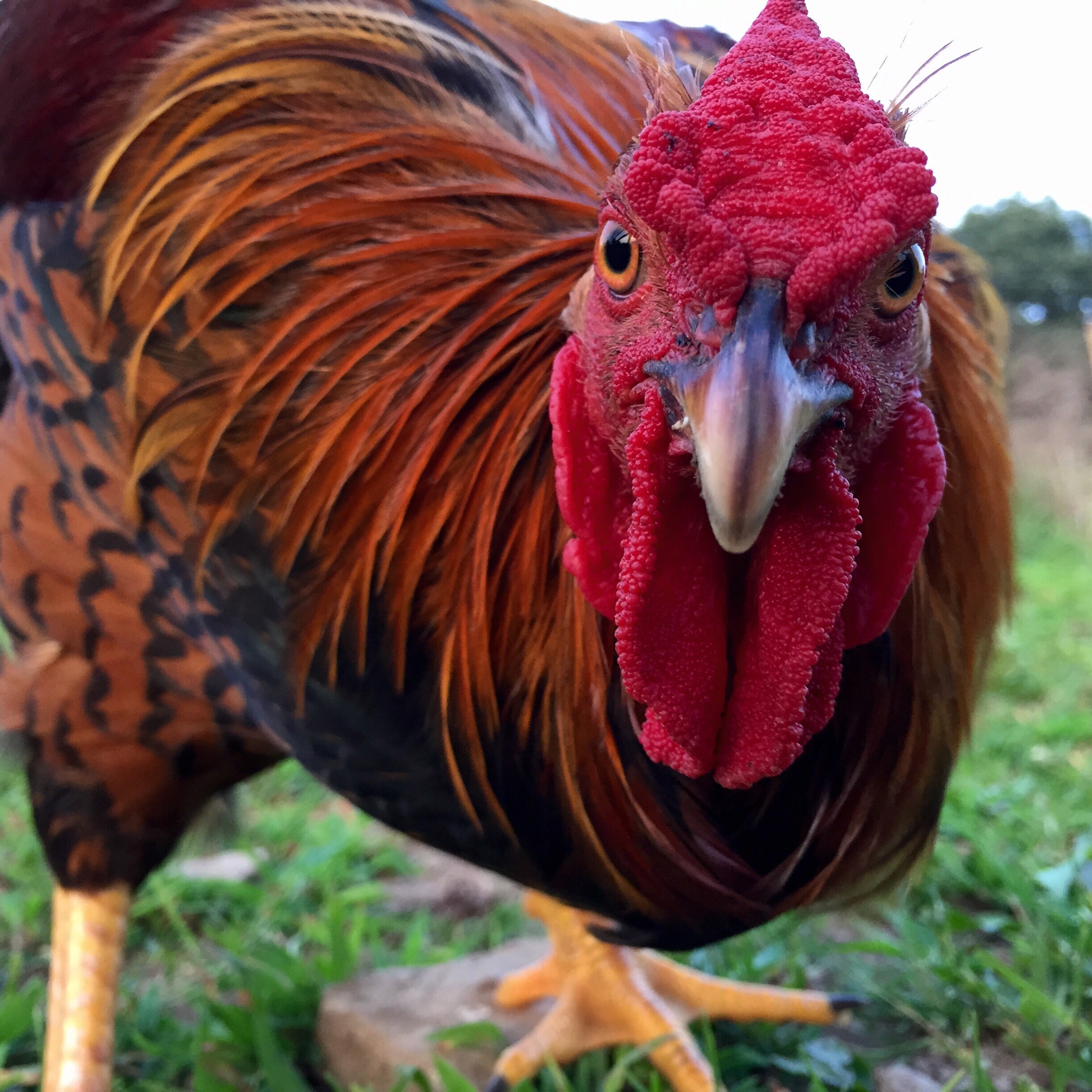
Our rooster, Nugget had wandered off of his many acre farm and was killed by the neighbors dog.  He was raised with our dogs, who are completely trustworthy with the birds.  When we relocated him to his new home (we aren’t able to house roosters in our neighborhood, due to the proximity of other homes and a roosters propensity for screaming in the wee hours of the morning), it was also home to 3 other trustworthy dogs-he wasn’t raised to have (what I now believe is a healthy) fear of dogs.

This is the first chicken I’ve lost, and I certainly did not think I would be as upset as I was.  Darn, it hit me right in the feels.  I truly believe you have a personal responsibility to all animals you choose to bring into your home and life, regardless of if they are pets or producers.  I have responsibility in the end, and let this little guy down.

Looking forward, I don’t see that it will get any easier- but these things happen, especially when raising livestock.  You do your best to protect and care for them-but inevitably these things happen.

There is so much care, time and love that goes into raising livestock and produce. You are hit with a bit of defeat every time a plant dies or doesn’t produce the way you think it should, all the time you spend tending to them seems wasted.  Then, the next morning when you’re collecting dozens of eggs or canning pounds of tomatoes- it all feels great, and makes perfect sense and you’re filled with happiness.  I cannot imagine the rollercoaster larger scale farmers ride, it makes me respect their process so much more.

See ya on the flip side Nugget-thanks for the lessons.
image

art of organics.

Trying to find new organic and natural products can be challenging and overwhelming, especially when you first decide to make the switch from their chemically laden counterparts. There are hundreds of fabulous small batch shops that create beautiful, safe and effective products- but unless you know where to look, they can be tough to find.  Art of Organics offers a solution, curating beautiful monthly theme based product boxes, and delivering them right to your door!

Every month you’re sent an email, going over the products offered in that months box and giving you the option to opt out.  The boxes are $58 a month with a subscription and $68 for a one time purchase (if they don’t sell out- they’re becoming quite the hot item)!  Both prices include shipping.  Each box comes with an outline of each brand and suggestions on using each product included, which is extremely helpful- and familiarizes you with the brands.

In the three months I have gotten boxes, I have NEVER been disappointed.  One month I did receive a broken Jade Roller, and within days of emailing their Customer Service department a new one arrived at my door! The customer service is phenomenal!

This months box has to be my favorite, the theme was “Sea” and it did not disappoint!  The box description pulled from the Art Of Organics website:

Inspired by sunshine filled days at the beach and the warm nights that follow. SEA provides everything you need to create a blissfully low maintenance beauty routine that makes you feel like a sun-goddess. Our collection of essentials will keep you hydrated, glowing and refreshed all summer long.

The Clean Beauty Box is a thoughtfully curated assortment of green beauty products, carefully nestled in biodegradable aspen excelsior and presented in a recyclable gift box featuring premium gift wrap and a natural cotton ribbon.

The first product I want to talk about is the Coconut + Mint Cooling Spray from Little Barn Apothecary.  I am familiar with this brand and have been using their Simple Face Oil for the past couple of months and love it.  (I want to mention I just tried to link the Simple Face Oil and couldn’t find it on their site-I will riot in the streets if I can’t buy it any longer and you can’t try it-it is divine!)  First, this product smells so clean and instantly cools your skin. Second positive- I’ve found it nicely moisturizing, and really enjoy using it on my face and neck as a refresher.  This product is a total win, especially in the Kentucky heat.

The next two products came from Leahlani, a brand I had never tried before-but boy I am glad I’ve discovered them.  The Mermaid Mask is my new goto, it is nice and thick which means it will last a while and it really works to brighten and moisturize your skin.  It smells great and feels nice going on.  I can see this working its way into my routine a few times a week because it is so enjoyable to use and beautifully packaged.  The second product that came from Leahlani was the Mahana Coco Infusion Oil.  This is a use anywhere oil, with sexy gold shimmer built in perfect to enhance that summer glow! Oh, and it smells AMAZING.

I have to say I was really hesitant to try the Soul Sunday Seacliff Wage Spray, with 2C/3A Curly hair I didn’t think this would work for me.  I was so wrong.  I tried this on a Saturday morning-spritzed it on my hair after the shower and let it air dry-the result was a great soft and easy curl.  I was so happy with it.  I have used it to liven up my hair after work, or give it a little more texture before I step out the door.  If you’re a curly girl (or guy!) like me, you should really give this a try, the price is super reasonable, and it smells like summer!

I look forward to the release of each and every Art of Organics box-it’s like celebrating your birthday each month.  I just love this company-they really, really get it!  There is no cutting corners, no skimping on packaging, and each box oozes care and thoughtfulness.  I hope you get the chance to check out all of these great companies, I guarantee you’ll love them as much as  I do!

woodford reserve.

I’ve lived in Kentucky for about five years, and there are still times I feel like a tourist- running around exploring new places and revisiting some of my favorites.  Central Kentucky is constantly growing and developing with new fun spots to visit popping up all around- it’s a great time to live and explore here.  Some of my favorite places to visit are oldies but goodies, rich in Kentucky history.

Woodford Reserve is my absolute favorite place to bring family and friends from out of town.  Located in Versailles, Woodford Reserve oozes Kentucky culture and history.  This bourbon distillery is the oldest in Kentucky, but like a good wine (or bourbon?) seems to get better with age.  Woodford’s history dates back to the late 1700s.

The distillery offers tours 7 days a week Monday through Saturday: 10AM-3PM EST and Sundays 1PM-3PM EST.  The tours take you around the meticulously maintained property, fill you in on the history and end with a tasting.  If you haven’t been, I strongly recommend taking the drive through the worlds most beautiful horse country.

nugget gets gone.

When we purchased our chicks, we purchased them sexed as females.  Sexing chickens can be really tough, so we weren’t too surprised when we ended up with one Roo.  As he aged, he turned into a beautiful golden boy-but as he grew, so did his voice.  It wasn’t too long before his vocal abilities were center stage-and he was singing the song of his people in the early morning light.

Living in a neighborhood, we knew that this wouldn’t work and we would have to relocate our dear friend Nugget.  Luckily, I have a friend who owns a larger farm and a flock of her own, she was willing to take him in.  Today we separated him from our girls, stuck him in the car and brought him to his new family.

Backyard chickens are becoming more and more popular as urban gardening takes off across the country.  It’s important to remember, that if you’re going to be an owner of backyard chickens- you be a responsible one.  One bad egg can ruin it for the whole group.

Noisy chickens and crowing roosters don’t make good neighbors (for some people).  It’s important to remember that, although you may love waking up to that sweet rooster song-there are many people who do not.  I recommend keeping your coop as far away from your neighbors as possible, keep it as clean as possible, and restrict your coop residents to hens.  Sharing the fruits of your labor doesn’t hurt either- who can look at a farm fresh egg and not smile?


a straw bale, what?

This year we knew we wanted to expand our garden, but wanted to do so as easily and as cost effectively as possible.  We stumbled upon straw bale gardening, and after a bit of research decided this would be the method for us.  The straw bales could be placed outside of our existing garden, didn’t require any additional building of raised beds, and would cut down on the amount of weeding we’d need to do (all big positives for us).

The unfortunate thing, is that you can’t just stick your plants in a straw bale and expect them to grow- the bales take some conditioning before they’re ready to plant.  Roughly 10-15 days before you’re ready plant, you need to begin a fertilizing and watering protocol to promote decomposition of the bales, and to put “food” into the bale for your plants to munch on as they grow.   Once this is done and you’ve got your plants set into the bales- you can continue on with any fertilizing program you choose to use.  To condition our bales, we chose to use Organic Plant-tone Plant Food from Espoma. This is a 5-3-3 mix, that we felt would give the bales the jump they needed to break down. This is mainly comprised of feather meal, chicken manure and bone meal- your dogs will find this concoction tasty-so make sure to keep it in a safe place (we learned this the hard way).

So far we’ve been really happy with the results.  If I were to do anything different- I would have staked each bale from end to end to keep them together.  As they break down, they get a little loose and start to wash out.  The bales that we planted tomatoes in, we staked at each end, knowing we’d need to tie up the plants.  These bales have held together much better and I think they hold water better.


My Personal Pros & Cons for Straw Bale Gardening

Pros:

  • Decreased influence of weeds
  • Plants seem less susceptible to rotting and slugs, as they’re elevated off the ground
  • Easy to maintain and prune-everything is raised
  • Low investment for the planting materials
  • Can be put anywhere

Cons:

  • They seem to dry out quickly and take A LOT more water (we had a hard time starting seeds due to this)
  • If they’re not staked, they’ll slowing spread and break down a bit faster
  • Not very aesthetically pleasing (we tried to plant marigolds and mulch around them for the look factor)

Overall I think we are pleased with our results.  The tomatoes have done really well, along with our zucchini, jalapeño peppers, pak choy and kale.  The most beautiful thing of all- is that we can turn around and move the bales to the compost pit for the winter, and use them as fresh compost next season!

the who’s who of the chicken coop.

When deciding on which chickens I wanted to fill my coop, I knew that I wanted breeds that were different and that I could buy from a local hatchery.  I lucked out and via Facebook, found a young girl who started hatching chicks for a science project-but then continued doing it for extra money when she enjoyed it so much!

She had several varieties and I decided to get a good sampling.  Her chickens were sold sexed-so I had the expectation of only hens. Sexing chickens is pretty tough-so now that I have 12 out of 13 that are hens, with only one rooster, I was pretty impressed with her work!


The Girls of Cluckingham Palace:

Ameraucanas: These are blue/green egg layers. From my experience, they’re the most flighty-which means they’re probably pretty smart and cautious.  They’re not the prettiest to look at, and have little beards and tufts of feathers around their ears.  If you let your chickens free range all the time, or really want pretty eggs- these may be a good bird for you!

Wyandottes: I have both the Silver and Gold Laced varieties. One of my chicks ended up being a Gold Laced Wyandotte Rooster.  These birds are super pretty, lay brown eggs and are a hearty bird.  Seem relatively smart and curious.  They’re definitely the nicest to look at in my coop.

Barred Rocks: These girls are the most friendly and a little silly! They are totally gluttons and will do anything for a worm.  They’re by far my favorite to interact with- but are not too predator savvy.  They will lay brown eggs as well and are known for being good layers, and cold weather hearty birds.

In picking the birds that are right for you and your family- it’s import to do your research.  Know your climate, your environment and the predators that will always be trying to weasel their way into your coop.  I recommend, if possible, buy local- the birds are probably suitable for your environment, and they will have less stress of travel and risk of disease.


what comes first, the chicken or the coop?

I feel like I know the answer to this one now, it’s a solid “Coop“.  But alas- in my chickenignorance, on a cold and snowy February day, a friend and I drove an hour to go pick up 13 (a cool-bakers dozen) mixed breed, week old chicks.  I was fairly certain, that we could complete our semi-finished coop by the time the girls were going to need to be moved outside.

I was blissfully unaware at the rate of which chickens grew- and within a week, they were flying the coop (or brooder).  In an attempt to contain them, that unfortunately failed, I split the brood into two separate brooders.  I believe now, that this essentially gave them more room for a running start to leap out of their confinement, but hindsight is 20/20. I guess at some point, I should mention that the chicks were living in our spare bedroom, which made the room less inviting for guests.

When we finally decided that the girls had overstayed their upstairs welcome, we built a large and tall temporary brooder in our unfinished basement.  This made all of us much happier, and as the girls continued to grow- I continued to drag my feet finishing the coop.  Then the inevitable happened: they began escaping their new, larger brooder and chicken coop crunch time began.

The coop interior, door and run was completed within a couple of weeks without major incident, and we moved the girls outside.


My advice to anyone wanting to get chickens:

Do it! They really are so much fun, but plan ahead.  I tend to like to do things a little bit spur of the moment, but with chickens that isn’t the best approach.  Have your brooder, coop and run all set before you bring them home.  More importantly, you have to understand your city and neighborhood laws before you begin the process.  The startup is costly, and it would be a shame to go through it all-to then have your girls get the boot out of town! If you’re really set on having chickens and its not allowed in your neighborhood or city- get to work on educating the neighborhood committee and city council to get the laws changed.  A simple google search will get you started in the right direction.